
You walk away from the crash, trade insurance information, and drive home. Two days later, you can’t turn your head to check your blind spot. That delay is common: adrenaline blunts pain in the first hours, and the inflammation behind whiplash or a disc injury builds over the following days. Feeling “fine” at the scene tells you very little about what actually happened to your spine.
The numbers back this up. The CDC counted more than 2.8 million emergency department visits for crash injuries in 2023. In earlier CDC data, imaging was ordered in about 70% of those ER visits, and roughly half of all crash-related visits involved a primary diagnosis of neck and back sprains, strains, or spinal disorders; exactly the injuries this article is about.
This guide explains what each scan can and can’t see, when providers order one over the other, and why the answer starts with a hands-on exam. If you’re searching for the best chiropractor in Lancaster after a crash, that exam-first approach is the thing to look for.
When To Go To The ER
Some symptoms mean emergency care first, imaging questions later. Call 911 or get to an emergency room if you have any of these after a crash: loss of consciousness or confusion, a headache that keeps getting worse, repeated vomiting, numbness or weakness that spreads, loss of bladder or bowel control, or severe pain along the middle of your neck or back.
In the ER, doctors often reach for a CT scan rather than an MRI. It’s much faster and more accurate than an X-ray at detecting complex fractures and internal bleeding. Everything below assumes the emergencies have been ruled out and you’re in the outpatient setting, deciding on next steps.
When Is Imaging Needed After an Accident?
Imaging is warranted when exam findings point to structural damage, not as a routine box to check. Clinicians use validated screening tools, such as the NEXUS criteria and the Canadian C-Spine Rule, to decide whether spinal X-rays are necessary. That’s why a thorough physical evaluation comes before any scan.
Findings that typically justify imaging include:
- A high-impact collision, pedestrian strike, or significant fall
- Inability to bear weight, walk, or perform basic movements
- Neurological warning signs: numbness, burning, or muscle weakness in the arms or legs
- Tenderness directly over the spine, or sharp pain with joint rotation
- Symptoms that don’t improve or get worse after several days of rest
What an X-ray Shows After an Accident
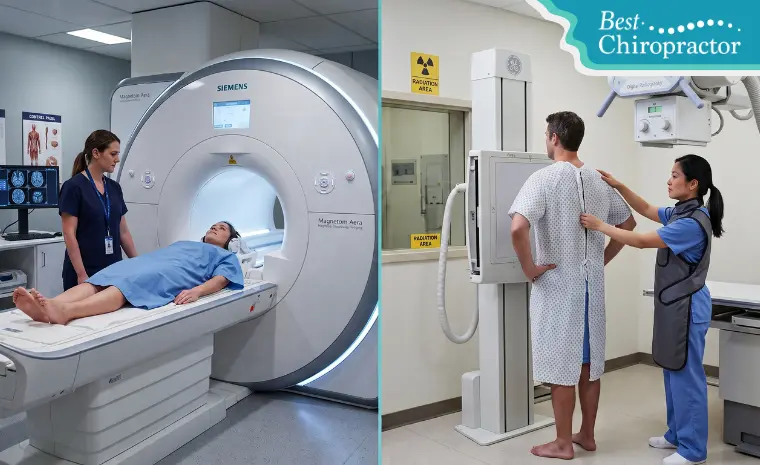
An X-ray answers one question fast: Is the skeleton intact? At low radiation doses, it produces high-contrast images of bone, making it the standard first-line scan in urgent care and chiropractic clinics alike.
It reveals fractures and dislocations, of course. But after a car crash, it does two other useful things. It shows alignment problems, like the loss of the neck’s natural curve (sometimes called “military neck” or straightened cervical lordosis), which muscle spasm from whiplash can cause. And it helps separate pre-existing arthritis or disc-space narrowing from fresh trauma, a distinction that matters enormously if an insurance company later argues your pain was “already there.”
Its blind spot is everything soft. X-rays pass straight through muscles, ligaments, and discs without recording tears or inflammation. For context on safety: a plain X-ray exposes you to roughly the same radiation you’d absorb from natural background sources over a period of days to a few months, depending on the body part, according to RadiologyInfo.org, the patient-information site of the American College of Radiology.
What an MRI Detects That an X-ray Can’t
MRI uses magnetic fields and radio waves — no radiation — to produce cross-sectional images of soft tissue, where most lingering accident pain lives. According to MedlinePlus, it’s the preferred tool for evaluating the spinal cord, nerves, and the surrounding structures.
An MRI captures what plain films miss:
- Disc damage. Bulging, herniated, or ruptured discs pressing on spinal nerves.
- Soft-tissue tears. Strained or torn ligaments, tendons, and deep muscles around the spine.
- Nerve root compression. The actual source of radiating symptoms like sciatica or arm numbness.
- Hidden bone injury. Marrow edema and micro-fractures invisible on a standard X-ray.
X-ray vs. MRI at a glance
X-ray | MRI | |
Best at showing | Bone: fractures, dislocations, alignment | Soft tissue: discs, ligaments, nerves, marrow edema |
Typical role after a crash | First-line screening and structural baseline | Follow up when nerve or soft-tissue signs appear |
Scan time | A few minutes | Roughly 20–45 minutes |
Radiation | Low, controlled dose | None (magnets and radio waves) |
Relative cost | Lower | Higher |
When Is an X-ray The Right First Step?
An X-ray comes first because it’s fast, widely available, inexpensive relative to advanced imaging, and it rules out the injuries that would make hands-on treatment unsafe.
If you visit a clinic shortly after a crash, that first X-ray establishes a structural baseline. It confirms whether your spine can safely handle conservative care — manual therapy, adjustments, rehab exercises — or whether something needs a specialist before anyone touches it.
When Is an MRI The Better Choice?
An MRI earns its cost when nerves or soft tissue are in question. Radiating pain, electric-shock sensations down a limb, or progressive weakness all point toward nerve involvement that only an MRI can map precisely.
The second scenario is stubborn pain. If soft-tissue symptoms persist for weeks despite conservative care, an MRI can uncover the disc tear or ligament instability that plain films missed. And if injections or surgery ever enter the conversation, the MRI is what specialists will want in front of them. In short, whether you need an X-ray or MRI after an accident comes down to what your body is telling the examiner: bone questions get X-rays, nerve and tissue questions get MRIs.
How Imaging Results Shape Your Treatment — And Your Injury Claim
Clear imaging replaces guesswork with a target. A muscle sprain and an acute lumbar disc herniation can feel similar in week one, but they call for very different treatment plans, timelines, and precautions. The scan tells your provider which road you’re actually on.
There’s a second function people underestimate: documentation. Under California Code of Civil Procedure § 335.1, most personal injury claims must be filed within two years. Timely, objective imaging ties your injuries to the crash with dates and findings, and insurers routinely point to delays and gaps in care to argue an injury wasn’t serious. Getting examined early protects your health and your record at the same time.